
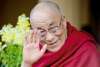



Dharamshala — The Tibetan Institute of Performing Arts (TIPA), Norbulingka Institute, and Nepal Tibetan Lhamo Association offered a long-life prayer to His Holiness the 14th Dalai Lama, at the Main Tibetan Temple (Thekchen Choeling Tsuglakhang) in Dharamshala on October 21, 2026. Around 5,000 people gathered to take part in these prayers, including Tibetans offering prayers for long life, as well as devotees and followers of His Holiness.
When His Holiness the Dalai Lama arrived from his residence at the Tsuglakhang courtyard, representatives of the Tibetan Institute of Performing Arts (TIPA), Norbulingka Institute, and Nepal Tibetan Lhamo Association — came forward to greet him. When His Holiness reached the edge of the courtyard, he stepped out of the golf cart in which he had travelled and walked towards the temple. He was greeted by Tashi Shölpa dancers, as well as dancing Snow lions and yaks, who performed to the sound of singers and the beat of drums.
The courtyard was magnificently decorated: a large photograph of the Potala Palace hung on the right-hand side of the courtyard and another photograph of Norbulingka (Lhasa) on the left. Sumptuous garlands of flowers hung from the canopy above their heads. The traditional red carpet, laid out in the centre of the courtyard, was also adorned with a series of auspicious symbols painted on red fabric. Whilst the monks escorting His Holiness played the horn, the TIPA performers sang and danced to welcome him.
When His Holiness appeared in the courtyard, thousands of people had gathered there; everyone rose to their feet, eager to catch a glimpse of His Holiness the Dalai Lama. Holding khatas in their hands, tears of happiness and joy streamed down their cheeks; as His Holiness passed by, they smiled and bowed in greeting.
At the foot of the temple, he paused to watch another group of dancers whose performance was particularly energetic. The TIPA artists continued to sing and dance as His Holiness made his way towards the temple, where he took his seat on the throne.
Ling Rinpoché, who presided over today’s ceremonies sat facing His Holiness. To his right was the Abbot of Namgyal Monastery, Geshé Lobsang Samten, and to his left the Dorjé Lobpön, Lobsang Dhargyey.
Today’s ritual was based on an Amitayus Ritual: ‘Extracting the Pure Essence’ composed by the Great Fifth Dalai Lama following a vision he had of Guru Padmasambhava in the form of Amitayus. The Eight Aspects of Guru Rinpoche and Khandro Yeshe Tsogyal were invoked. Following a praise to the Three Jewels there was a recitation of ‘Clouds of Ambrosial Blessings’, a prayer that recalls the sublime series of His Holiness’s previous lives, thirty-six in India and more in Tibet, including the line of kings who first ruled the Land of Snows.
The ritual proceeded with steps to expel obstructions, form the protection circle, supplicate the lineage masters, bless the long-life substances and the tormas, visualize Amitayus, bless the tsok offerings and so forth. There followed a section about repelling the seduction of the five classes of dakinis derived from a dream of Terdag Lingpa, a close associate of the Great Fifth Dalai Lama. The verses here evoke the qualities of the Lama and end ‘may you remain firm’.
The actual long-life offering began with a supplication to the lineage masters and continued with an offering of long-life substances. Ling Rinpoché offered His Holiness the long-life arrow which he flourished before him. Supported by representatives of the patrons Rinpoché then made a mandala offering accompanied by a request that, out of compassion, His Holiness would live long. He then offered a statue of White Tara, a scripture and a stupa—representations of the body, speech and mind of the enlightened ones. Next, he offered long-life liquor, long-life pills, the eight auspicious symbols, the seven royal emblems, and the eight auspicious substances. Meanwhile, the line of patrons, many of them carrying statues, moved swiftly past His Holiness’s throne through the temple.
The prayer for His Holiness’s long life composed by his Tutors was recited. Members of the Nepal Tibetan Lhamo Association offered statues of Thang-tong Gyalpo, reputed founder of the Tibetan opera tradition, Milarepa and King Songtsen Gampo.
The next prayer for His Holiness’s long life was ‘The Melody of the Nectar of Immortality’ composed by Jamyang Khentsé Chökyi Lodro. His Holiness was presented an appliqué thangka depicting Yellow Yamantaka and a painting of White Tara.
TIPA performed one song for His Holiness’s long life, then another that had been composed to celebrate his 90th birthday. The Nepal Tibetan Lhamo Association sang a song to celebrate their 50th anniversary.